Cyclical Nature
Learn how to chart your cycle, read your body’s biomarkers, and build awareness and authority over your hormone health and fertility.
Clinical restoration meets feminine design in this 12-week mentorship to restore your hormonal vitality and rebuild from the root.
Cyclical Nature intake begins in…
Presenting: Cyclical Nature
A fourteen week cycle charting accelerator and terrain-based functional wellness methodology.
Inside, you’ll learn how to track and interpret your four fertility biomarkers,
designed for you to learn how to track and understand your fertility biomarkers, use functional lab testing to identify the weeds and
craft beautiful, filled out cycle charts
master the art of reading fertility biomarkers
amplify your understanding of hormones
elevate your personal plan with functional lab testing
rise to a new level of confidence and awareness in your body
Ready to stop spinning and start restoring?
Introducing: Wildflower
A 12-week mentorship to restore your hormonal vitality and rebuild the feminine architecture your body was designed to thrive within. We move through three phases of my Garden Method — stabilize the soil, clear the weeds, seed + bloom — a healing framework I’ve built over multiple years of clinical practice and lived experience.
In 14 weeks, learn how to craft a beautiful cycle chart, track and understand your fertility biomarkers, use functional lab testing to gain insight into your hormones, and step into a new season of confidence and awareness within your body.
There’s a kind of depletion that doesn't show up on labs or trackers. It shows in your cycle as missing, erratic, or painfully present. In the bloating that follows even healthy meals. In the cravings, the puffiness, the skin flares. In the morning coffee you just need to feel like yourself.
You’ve been diligent, but your system is still on edge. You’ve reached the edge of surface solutions. You’ve tasted wellness, but haven’t felt restored.
The truth is, this was never just hormonal. It’s terrain. It’s the gut–liver axis under strain, nervous system architecture never taught, and emotional imprints your body keeps recycling. Rhythm never modeled, and safety never felt.
Your feminine physiology isn’t failing you; it’s adapting to a life you’ve outgrown and asking for a new blueprint.
She’s waiting for you to come home.
You want a body that feels like home.
To bleed with rhythm.
To eat without second-guessing.
To feel desire, warmth, and steadiness return. To feel your intuition louder than your symptoms and your skin belongs to you again..
You are done treating your body like an endless self-help project to solve; you want restoration that holds, guided by method, delivered at your pace, and rooted in your feminine design.
You want your days to match your values, stop spinning in survival and start creating from devotion.
And maybe for the first time ever, you want your health to feel like home; garden to return to, tend to and thrive in.
To become fertile again, whether with life, with love, or with legacy.
She's still in there... the version of you who trusts herself.
Step into a world where…
Knowing when you ovulate isn’t just an educated guess…
and you have a real, science-backed strategy to confirm your cycle’s story and make truly informed decisions about sex and everything else in your entire life.
Your period is never “late” again…
You receive comprehensive lab testing to identify opportunities to improve your hormone function…
The practice of charting your cycle means you never have to outsource your wisdom…
You have a deep confidence in yoru body’s cyclical nature, and it shows in the way you nourish yourself, spend your energy, and hold down your boundaries…
because you know there’s no such thing as a late period, and you know how to use your chart to accurately anticipate the start of a new cycle.
so you can be extremely precise with support your body actually needs.
because relying on an algorithm to tell you (a human, not a computer) when your period is coming, when you “should” be ovulating, or when to have sex is insane.
and you permanently drop the stress and disconnetion that comes from not knowing what your cycle is doing or what to expect.
Wildflower is for you if…
You are done outsourcing your rhythm. You feel like a stranger to your own body and you’re ready to root into your real hormonal pattern and experience what it’s like to bleed, digest, desire, and glow on your own terms.
You crave restoration that goes deeper than a protocol. You want a method that knows your terrain needs tending before it blooms — a way to become well.
You lost trust in your body and you want it back. You’re ready to feel safe in your body again. It's clear, responsive, and on your side.
You want to make space for fertility, whether or not you are TTC. You’re here to reclaim your capacity to create and restore the feminine design your body was born for, fertile with life, love, and legacy.
You are ready to be led. You’re done spiraling alone and you’re ready to be led inside a structure that is clinical, intuitive, and deeply restorative.
welcome to where we make xyz happen.
what if you could trust yoru cycle over an app?
Hey! I’m abby.
I help women master the art of charting their cycle, so they can understand their fertility, test their hormones with ultimate precision, and make informed decisions for themselves no matter what stage of life they are in - trying for a baby, trying to avoid pregnancy, improving their health, or stepping into perimenopause (the bit before the big Menopause thing)
I founded The monarch method after struggling with my health for over a decade (and putting myself into remission). After years of battling with my hormones, birth control, and crazy side effects, i found myself starting over: i wanted to be hormone free, but still have authority over my cycle and health. I wanted to understand what my body was telling me.
So, i learned how to track my cycle with science-backed methods. This became even more relevant to my work as i grew my functional wellness practice to include functional lab testing. Testing hormones at the right time of the cycle is crucial to getting clean results. standard recommendations for testing (day 21, in a 28 day cycle) are not helpful if ovulation timing isn’t regular, or if cycles are long, or if the body attempts ovulation and is unsuccessful.
Today, Cyclical nature works to help women who doent fit a standard mold - because the method is science backed, accessible to all walks of life, and easy to carry through seasons. The monarch method’s support has helped woemn become pregnant, understand their fertility, avoid pregnancy, and plan family timing without outsourcing their body’s wisdom to an app or an algorithm..
inside cyclical nature:
we’re
you become the expert on your cycle as you learn how to interpret your body;s story
we’re rewriting the script for how you participate and relate to your cycle
we’re turning your biomarkers into your story.
Here’s what drives women insane:
Their cycles are long or varying lengths and they feel like there’s no pattern to be followed
Their periods come like clockwork, but their bleed is weird or heavy, they’re symptomatic and painful, and PMS rages. Don’t forget the headache.
They’re told by their doctor that hormonal birth control is the only option for symptom or fertility management
Being unsure of what their body is doing - especially if they dont feel well - leading to impatience and resentment
Wanting to be a cycle-honoring queen, but being overwhelmed and lost trying to learn online (NO, ovulation doesn’t happen on day 14 for everyone)
Who i work with:
Women who are ready to go beyond surface level understanding of their cycle, hormones, and health status
You are coachable, receptive, and committed to taking the time to learn a new skill.
You sincerely care about seeing things through and want to do the best jonb possible to care for yourself.
You want a method of cycle tracking that can grow with you and support you in all seasons of life.
You are not focused on overnight fixes or the newest trends or hacks - you want to collect high quality data and let your body lead.
If you want these things, the fastest way to get there is to learn a method and test your biomarkers for the most accurate data TO YOU - no more looking to ourside sources. Look inside.
RIGHT NOW is the right time for you - you have space in your life that allows you to learn right now
Enter Cyclical nature - a step by step system for creating data driven, filled out cycle charts and functional lab testing that will usher in a new era of body literacy for you.
CYclical Nature:
Gives you science based biomarkers every single week to learn and practice
Created by someone who has been charting for years, teaching others to chart, and is well versed in functional lab testing for homroes.
Teaches you how to succeed without needing to outsource your knowledge to an algortihm or fancy tech
Supports you with 247 chat access, unlimited daily a personal helath portal, and check in sessions to review your charts and lab results
Teaches you how to tune into your body’s fertility signs and develop a deeply respectful relationship to your cycle
Cares deeply about body literacy and stripping away the fluff so you can focus on what matters - reading your body in real time
I created this offer differently because i was frustrated with the lack of nuance and accuracy in the industry.
Here’s how it works:
When you sign up to work with me, we’ll start with a one on one zoom session to talk about your goals and health history. From there, we’ll develop a plan to move your thorugh the following steps:
Setting up your chart
Learning hormones and anatomy
Learnign 4-5 cyclical biomarkers and how to chart them
Dutch testing
Learnign the interplay between endocrine and ovarian systems, stress, cortisol, etc
Cyclical licing and how to bring it all together
With bonus content Sex matters: contraception, herbal plan b, medications for plan b, miscarriage, abortion, birth control
Post birth control plan (make it shareable)
Preconception, ttc, pregnancy, postpartum
Perimenopause
Menopause
The DUTCH Complete is a comprehensive hormone test that analyzes your sex hormones, adrenal function, and detox pathways. It gives us detailed insights into how your hormones are produced, metabolized, and impacting your energy, skin, and fertility.
Tell me about the lab:
DUTCH TESTING
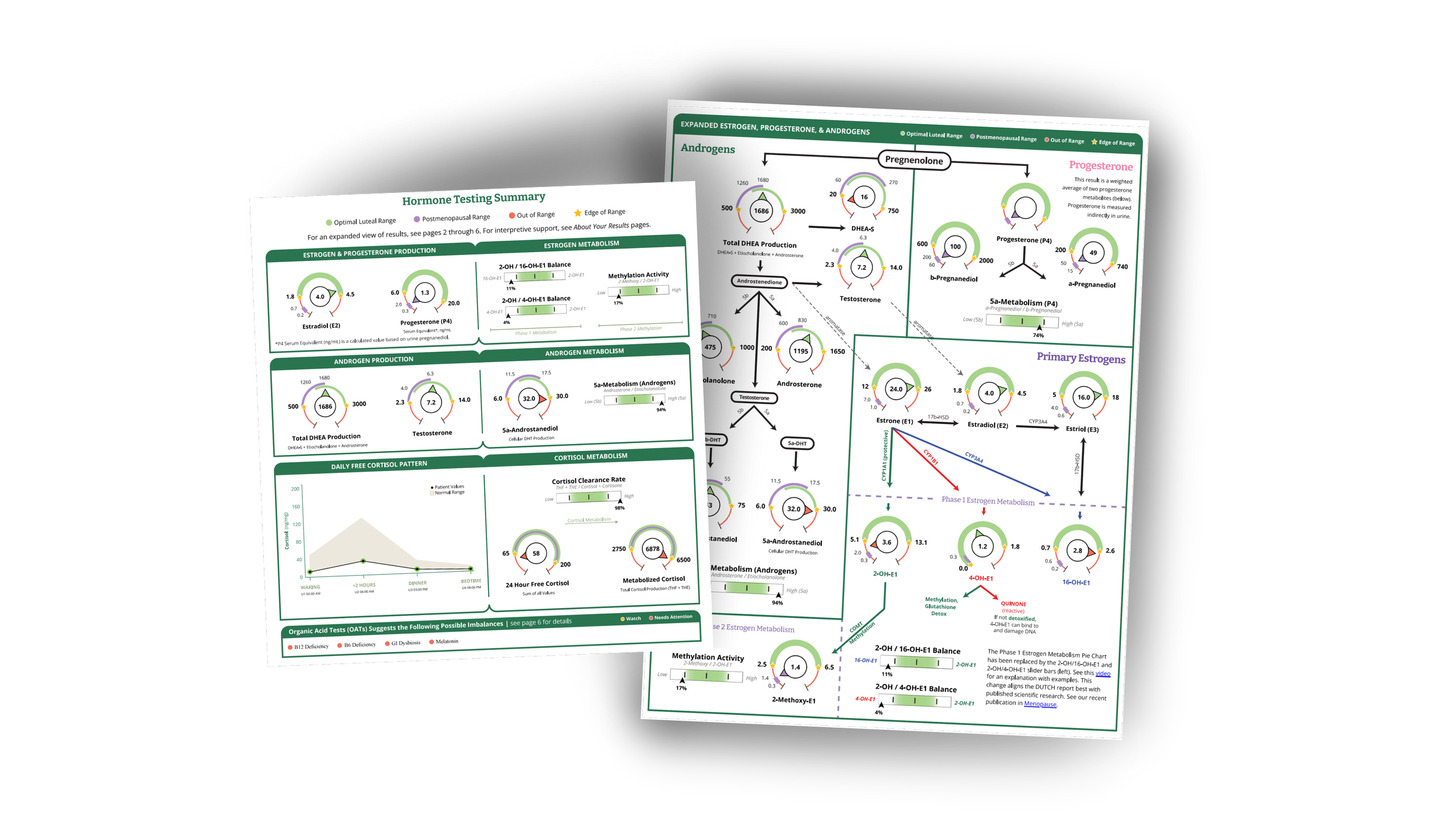
Preconception Health & Hormones: Balanced hormones are key for optimal ovulation, egg quality, and cycle regularity. The DUTCH Complete provides a deep look at estrogen, progesterone, and androgens, as well as cortisol patterns that influence reproductive health. By identifying imbalances early, we can create a targeted plan to support hormone optimization and prepare your body for a smoother conception journey.
Nervous System & Cortisol: Cortisol, melatonin, and neurotransmitter markers revealed through DUTCH testing offer a full picture of your stress response and circadian rhythm. If cortisol patterns are dysregulated, it can leave you feeling wired, anxious, exhausted, or unable to truly rest. DUTCH helps us build a strategy to recalibrate your nervous system, improve resilience, and support deeper recovery and emotional balance.
Hormone Balance: The DUTCH Complete doesn’t just show you hormone levels — it shows how your body metabolizes and clears them. This gives a clear picture of whether estrogen dominance, progesterone insufficiency, adrenal dysfunction, or androgen imbalances are driving your symptoms. With this insight, we can create a customized roadmap to stabilize hormones, support detox pathways, and restore overall endocrine health.
Nervous System & Cortisol: Cortisol, melatonin, and neurotransmitter markers revealed through DUTCH testing offer a full picture of your stress response and circadian rhythm. If cortisol patterns are dysregulated, it can leave you feeling wired, anxious, exhausted, or unable to truly rest. DUTCH helps us build a strategy to recalibrate your nervous system, improve resilience, and support deeper recovery and emotional balance.
TESTIMONIALS
WHAT’S INSIDE: receivabes
X weeks of detailed curriculum
X check in sessions
Daily messaging support
X training videos
Access to library of supportive resources
DUTCH test, protocols
Want to work together?
Click the button below to book a discovery call with me. On the call, we’ll get to know each other, you’ll share about your story, and we’ll talk goals. We’ll identify the things that have been standing in the way of your hormone progress and how to fix them once and for all.
Ps. if you need a custom payment plan, or have questions about logistics, that will be discussed on this call. Write down any questions you have about cyclical nature and I can show you how it all works.
At the end of our call, one of two things will happen: you’ll either be a perfect fit for the program, and I’ll extend an invitation to become one of my clients, or
If its not a good fit, that’s totally okay! There’s no obligations on your end - I will suggest something else you can do and point you in the right direction.
Talk to you soon!